Reckitt’s Dettol Banega Swasth India initiative demonstrates how combining climate-resilient school infrastructure, hygiene education and community collaboration improves hand hygiene, child health outcomes and resource sustainability.
Children in Dettol Climate Resilient Schools are 3.5 times more likely to meet all hand hygiene criteria than children in non-intervention schools, according to an independent study by AIIMS Rishikesh.
Independent evaluation by AIIMS Rishikesh revealed children are becoming ambassadors of change in hygiene practices within their families and communities.
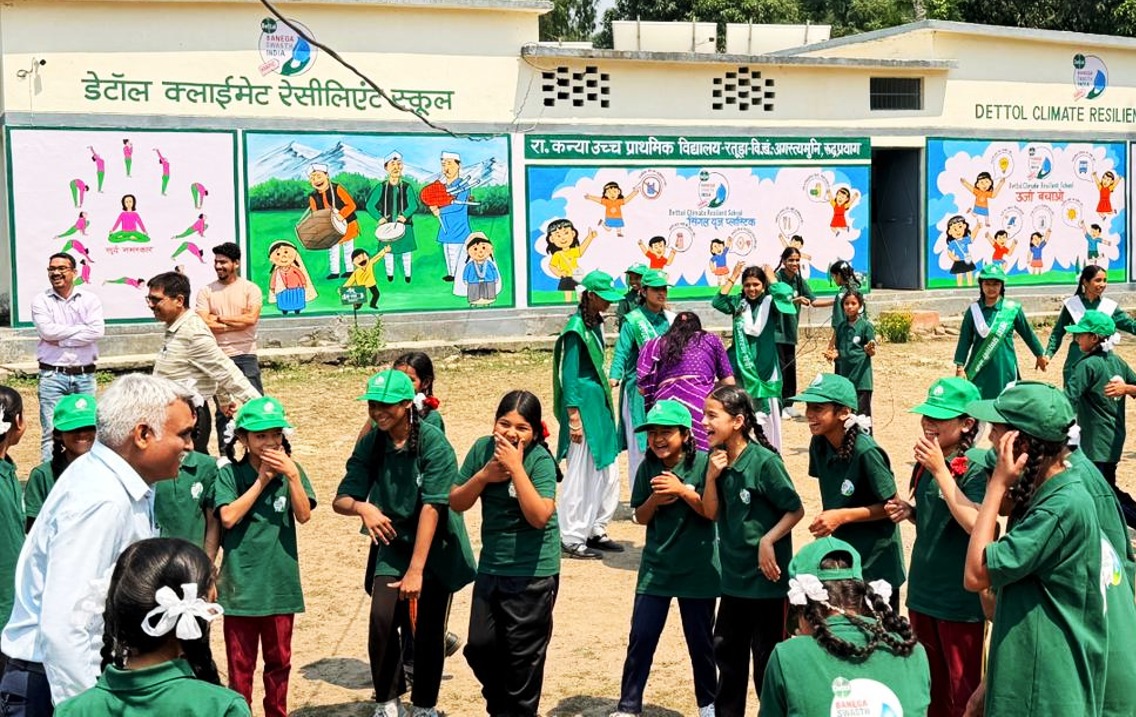
In Uttarakhand’s government schools, children are washing their hands differently. More students are now consistently washing their hands with soap and water and meeting critical hand hygiene criteria. Not because they were told to once, but because the habit has been built into their environment, their lessons and their daily routines. This shift from awareness to embedded behaviour is at the heart of the Dettol Climate Resilient Schools (DCRS) programme. And independent research is now confirming how far that shift is going.
Climate change is reshaping the conditions in which children learn and grow. Extreme weather events, water scarcity, and disrupted sanitation are already a reality for millions of families, particularly those in climate-vulnerable regions like Uttarakhand. Reckitt partnered with the Provincial Government of Uttarakhand to launch the DCRS programme through our flagship Dettol Banega Swasth India initiative, in 2023. Gaurav Jain, Executive Vice President, South Asia at Reckitt, noted that "We did so, driven by the belief that addressing these challenges meaningfully requires action at the grassroots - in schools, with teachers, and alongside communities."
A model built for lasting change: the 3Cs
The programme works through three interconnected pillars.
Campus
Upgrades school infrastructure such as safe drinking water, improved sanitation and energy-efficient systems to ensure that learning is uninterrupted even as environmental conditions shift.
Curriculum
Brings climate literacy into the classroom through tools including a Climate Dictionary and STEM-based learning kits, making hygiene and sustainability concepts practical and age-appropriate.
Collaboration
Extends impact beyond the school gates by engaging teachers, parents and local institutions, so that children’s learning becomes everyday practice at home.
What the evidence shows
In 2025, the All India Institute of Medical Sciences (AIIMS) Rishikesh – one of India’s premier medical institutes – conducted an independent impact evaluation across 13 government schools in Uttarakhand, which included four DCRS intervention schools and nine control schools. Prof. Vartika Saxena, Head of the Department of Community Medicine, at AIIMS Rishikesh, describes what they found: “Students in the intervention schools showed stronger hand hygiene practices, greater awareness of safe water and waterborne diseases, and benefited from improved access to clean water and sanitation facilities. The interventions have helped create school environments that protect children’s health and enhance their opportunities to learn.”
The results were as follows:
Hand hygiene behaviour improved significantly:
94.1% of students in intervention schools observed washing their hands with soap and water, compared to 81.8% in non-intervention schools. Notably, 18.3% of students met all critical hand hygiene criteria, compared to 5.3% in non-intervention schools.
The health outcomes were equally striking. After a year, rates of moderate-to-severe stunted growth fell by 76.4% in intervention schools, compared to 63.2% in control schools.
No bacterial or parasitic infections were detected in DCRS schools. Attendance held consistently at 87–92%, even during periods of environmental disruption, and 14.3% of students reported above-average health-related wellbeing.
The programme also delivered on resource sustainability as schools achieved a 65% reduction in water usage and a 64.5% reduction in electricity costs.
Commenting on the findings, Prof. Saxena noted that “The interventions under the Dettol Climate Resilient Schools Programme have helped create school environments that protect children’s health and enhance their opportunities to learn.”
Healthier communities are built through everyday actions and behaviours. Gaurav Jain, Executive Vice President, South Asia at Reckitt, sees this as central to Reckitt's purpose, expressing that “The findings from AIIMS Rishikesh demonstrate how simple, consistent interventions can improve health outcomes. It is critical to equip children with the knowledge and habits needed to navigate the realities of their environment so that they can become catalysts for lasting change that extends beyond the classrooms to households and to their communities."
Climate disruptions will intensify, and the communities most exposed have the fewest resources to adapt. The Dettol Climate Resilient Schools programme demonstrates what is possible when science, infrastructure and community engagement work together to empower children in leading change.
Share to
Latest Press Releases
Discover how Reckitt’s people and brands are making a difference every day. From breakthrough innovations to community impact, explore the stories that drive our mission.




.jpg?width=634&height=354&format=webp&quality=60)